Key Takeaways
Choosing among premium IPTV services takes more than counting channels. Check the content, performance, device support, policies, security, and help available before you pay.
- Confirm that the live channels and on-demand titles match your viewing habits.
- Test playback during busy hours, not only during a quiet afternoon.
- Check supported devices, simultaneous streams, and app usability.
- Read trial, refund, renewal, and connection-limit terms carefully.
- Prefer transparent providers with clear rights, secure apps, and responsive support.
Understand what premium IPTV services offer
Premium IPTV services generally bring live television and on-demand programming together through an internet connection. The experience can feel closer to a traditional TV package when navigation is simple and the program guide is accurate. Still, features vary considerably between providers, so it helps to separate useful everyday functions from impressive-sounding promises. A practical IPTV streaming guide can also help clarify the basics before you compare plans.
Live TV, on-demand content, and replay features
Start by deciding how you actually watch television. Live channels matter for sports, news, and scheduled shows, while a video-on-demand library is more useful when you prefer to choose a film or series at any time. Replay or catch-up features can help when you miss a broadcast, but they should be listed clearly rather than assumed from the presence of live TV.
Ask whether replay applies to every channel or only selected programming. Also check how long content remains available, whether subtitles and multiple audio tracks are offered, and how quickly new titles appear. These details often matter more than a large headline channel count.
HD, Full HD, and 4K streaming quality
Resolution is only one part of picture quality. A stream may be labeled 4K yet still look disappointing if the source is weak, compression is heavy, or your connection fluctuates. Look for clear information about available quality levels and whether the app adjusts playback when network conditions change.
A premium experience should also be judged on consistency. Watch several types of content, including fast sports action, dark movie scenes, and ordinary news broadcasts. Consistent picture quality matters more than a single attractive demo channel.
Multi-device access and simultaneous streams
Households often want to watch in different rooms, or switch from a television to a phone without starting over. Before subscribing, confirm the number of permitted connections and whether simultaneous viewing is actually included in the plan. “Multi-device” may mean that an account works on several device types, not that every device can stream at once.
Write down the devices you expect to use and compare them with the provider’s support list. This simple step avoids paying for a plan that works well on one screen but not on the others.
Electronic program guides and recording options
An electronic program guide should make live television easier to browse, with readable listings, useful time navigation, and sensible categories. Check whether guide data is updated regularly and whether the schedule reflects your region. A guide that is several hours wrong quickly becomes frustrating.
Recording is a separate feature and should never be presumed. Find out whether recordings are supported, where they are stored, how long they remain available, and whether there are limits on storage or the number of programs saved.
Compare channel lineups and content coverage
A broad lineup is valuable only when it contains the channels you genuinely watch. Compare categories, regional feeds, language options, and the depth of the on-demand catalog instead of relying on a total number. The best choice for one household may be poor for another because viewing habits and location differ. This IPTV provider comparison offers a useful framework for weighing content alongside stability and pricing.
Checking sports, news, entertainment, and international channels
Make a short list before opening a provider’s channel guide. Include must-have sports networks, local news, children’s programming, movie channels, and international stations if they are part of your routine. Then verify the exact channel names and regions, since similarly named feeds may not carry the same programs.
A focused check is faster and more reliable than scrolling through thousands of entries. Look especially for the channels that would make you cancel the subscription if they were absent.
Matching regional availability to your location
Regional availability can affect local news, sports rights, language options, and the channels visible in your guide. Enter your location when a provider requests it, and ask support about local feeds before subscribing. If a service uses broad geographic language without identifying actual coverage, treat that as a reason to ask questions.
Your internet location may also affect playback or access. Use the provider’s published guidance and avoid assuming that a channel available in one country will be available everywhere.
Reviewing video-on-demand libraries
For on-demand content, examine both variety and freshness. A useful library should be easy to search and should identify genres, languages, release periods, and perhaps subtitle availability. Check whether the catalog is genuinely included in the plan or presented as an optional add-on.
Use a few specific titles as a test rather than judging the library by its front page. Search for older favorites as well as newer releases, because a polished home screen can conceal a narrow catalog.
Identifying missing channels and blackout restrictions
Blackouts and missing feeds are especially relevant to live sports and regional programming. Providers should explain whether certain events may be unavailable because of geographic rights or other restrictions. Read the terms and ask direct questions about the channels you consider essential.
Keep a written record of the answer if the information comes from support. A clear response is useful; vague assurances such as “everything is included” are not enough to make a confident decision.
- List the channels you watch every week.
- Mark which ones are essential and which are optional.
- Check regional feeds and likely blackout conditions.
- Recheck the lineup during the trial period.
This small checklist turns a vague content comparison into a decision based on your own habits. It also gives customer support something specific to confirm before payment.
Evaluate streaming performance and reliability
A service can have an excellent catalog and still be unpleasant if playback repeatedly pauses. Reliability depends on the provider’s infrastructure, your home network, the device being used, and the quality of the stream itself. Test more than one channel and more than one resolution before forming an opinion. Practical advice on streaming optimization can help you distinguish a provider issue from a local setup problem.
Server stability and buffering prevention
Buffering may come from overloaded servers, weak Wi-Fi, insufficient bandwidth, or a device struggling with playback. Try a wired connection where possible, move closer to the router, and compare results across devices. If only one channel fails, the issue may be specific to that stream rather than the entire service.
A useful test includes changing channels several times, pausing and resuming playback, and watching a fast-moving program. Notice whether recovery is quick or whether a small interruption causes a long wait.
Connection speed and bandwidth requirements
Your connection must carry the stream while leaving room for other household activity. Video calls, game downloads, cloud backups, and several simultaneous viewers can all reduce the available bandwidth. Ask the provider for its recommended speeds at each quality level, then test your connection at different times.
Do not rely on a single speed-test result. A stable connection with modest speed may perform better than a faster connection that drops or varies sharply.
Peak-hour performance and service uptime
Evening and weekend testing is valuable because demand is usually higher when more people are watching. Compare playback at those times with a quiet morning session, and record whether channels take longer to load or quality falls. A provider’s uptime language should be read alongside the terms, not treated as a substitute for your own trial.
Use the trial to test ordinary viewing rather than leaving one channel running in the background. Reliability means the service behaves predictably across the programs and times you care about.
Adaptive streaming and picture quality controls
Adaptive streaming can lower quality briefly when the connection weakens, helping playback continue instead of stopping completely. Manual quality controls are also useful when you want to balance sharpness against bandwidth. Check whether the app exposes these settings and whether changes take effect without restarting the stream.
Watch for sudden shifts between blurry and sharp images. Occasional adjustment is normal on a variable connection, but constant changes may indicate that the service or network cannot sustain the selected quality.
Check device compatibility and user experience
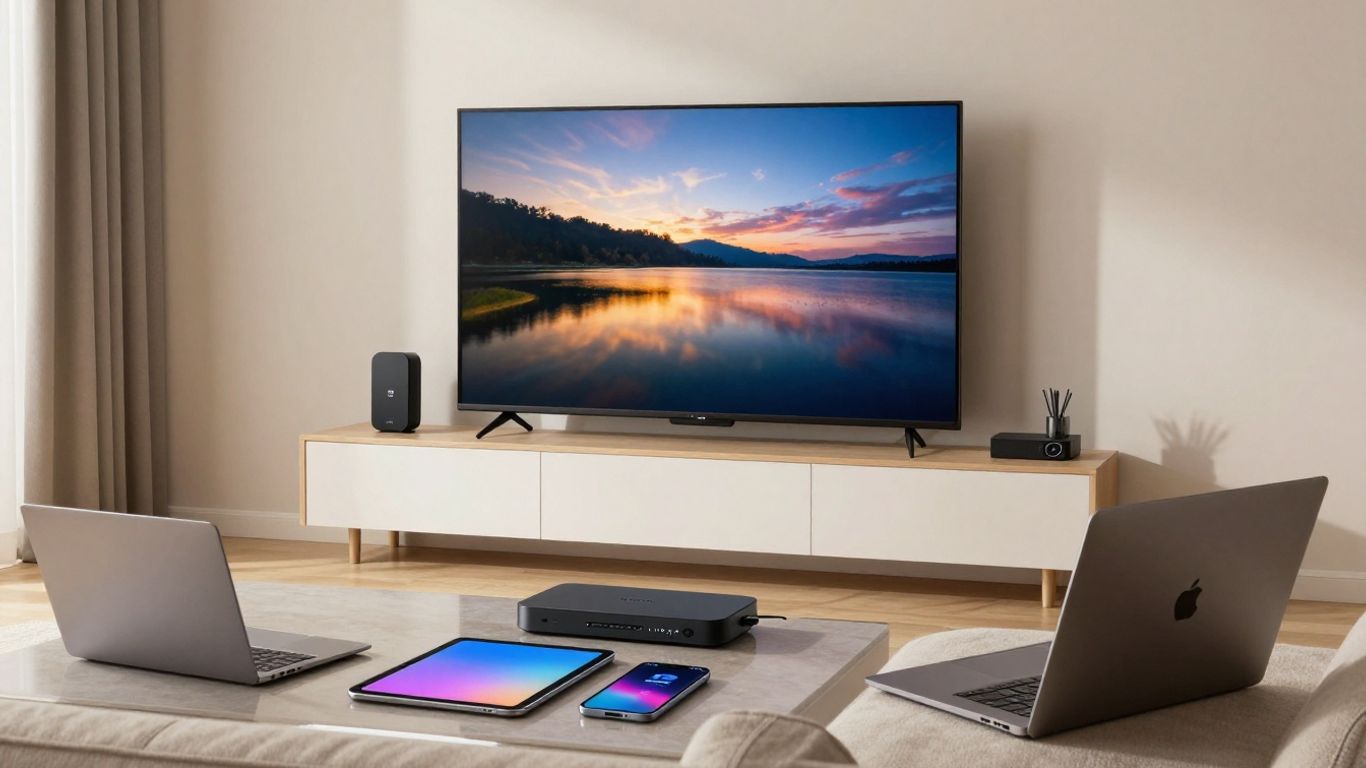
Device support affects more than whether an app can be installed. The interface should remain readable on a television, responsive on a phone, and easy to operate with the controls you already use. Check the provider’s setup instructions before purchasing, especially if your household mixes smart TVs, streaming sticks, mobile devices, and computers. A broader device compatibility guide can help you prepare a practical checklist.
Smart TVs, streaming sticks, and set-top boxes
Confirm the exact operating system and model family supported by the app. Smart TVs can differ by year and region, while streaming sticks and set-top boxes may have different installation steps. If you are buying a television for a rental property or guest room, guidance on rental TV features can also be useful when considering simple interfaces and durability.
Look for clear instructions, current app availability, and a fallback option if the preferred app is unavailable. Installation should not require unexplained downloads from an unknown source.
Mobile devices, tablets, and computers
Phones, tablets, and computers are convenient for travel or second-room viewing, but they reveal different usability problems. Check whether the player handles portrait and landscape orientation, whether subtitles are readable, and whether the service supports the browsers or operating systems you use.
Test playback on mobile data only if the provider permits it and you understand your data allowance. A stream that works on home Wi-Fi may consume more data than expected away from home.
App installation, navigation, and search tools
A good app gets you from launch to playback without unnecessary friction. Browse the guide, search for a known title, open a category, and return to a live channel to see how the controls behave. A IPTV Pro configuration guide may help users who need to understand setup choices, but the provider should still explain the steps in plain language.
Pay attention to loading times, favorite-channel tools, parental controls, subtitle settings, and the way the app handles errors. These small interactions shape the experience far more often than a promotional feature list does.
Support for multiple users and household viewing
Household viewing requires clear account rules. Determine whether profiles are available, whether favorites are separated, and how simultaneous streams are counted. A plan that supports several devices may still restrict concurrent playback or require separate credentials.
Ask how devices are added and removed, too. Straightforward account management is especially helpful when family members use different screens or when an old device is replaced.
Review pricing, plans, and provider policies
Price should be considered together with content, reliability, and the amount of support included. A low monthly figure is not necessarily good value if the service lacks essential channels or makes cancellation difficult. Compare the full cost over the period you expect to use it, including taxes, add-ons, and extra connections. Clear billing practices are easier to evaluate with a subscription billing guide, even though the guide is written from a broader billing perspective.
Monthly, quarterly, and annual subscription options
Monthly plans reduce commitment and are useful while you test a service. Quarterly or annual plans may suit viewers who have already confirmed the lineup and performance, but longer terms deserve closer review. Do not let a discount pressure you into paying for a year before you know whether the service fits your household.
A simple comparison can make the trade-off visible:
| Plan term | Best for | Main question |
|---|---|---|
| Monthly | First-time testing | Can I cancel easily? |
| Quarterly | Short-term commitment | Is the discount worth the added commitment? |
| Annual | Established viewing habits | What happens if the service changes? |
After comparing the terms, calculate the real cost per month and note the cancellation process. The cheapest displayed rate may depend on an upfront payment or an automatic renewal.
Free trials, refunds, and renewal terms
A free or low-cost trial is most useful when you treat it as a test period. Read when it ends, whether payment details are required, and whether the subscription renews automatically. Refund rules should identify the request window and any exclusions rather than simply promising satisfaction.
Use the trial to test the channels, devices, peak-hour performance, and support response that matter to you. A few minutes of casual viewing cannot answer all of those questions.
Limits on connections and supported devices
Connection limits should be stated before checkout. Check whether the limit applies to registered devices, active streams, or both, and find out whether adding a device costs extra. Also verify whether a plan change takes effect immediately or only at the next billing period.
These details are easy to overlook when comparing headline prices. They become much more significant when several people watch at the same time.
Transparent pricing and hidden fees
The checkout page should show the subscription price, billing frequency, taxes where applicable, and any optional charges. Be cautious when a provider pushes you toward an unfamiliar payment method or avoids publishing basic terms. Keep the receipt and confirmation email so you can refer back to what was purchased.
A transparent provider makes it reasonably easy to understand what you receive and how to stop paying. That clarity is part of value, not an administrative extra.
Prioritize privacy, security, and legal considerations
Internet television involves account credentials, payment details, and viewing activity, so privacy deserves the same attention as picture quality. Use official app sources where available and protect the account with a unique password. Before installation, review the provider’s terms and privacy information rather than accepting every prompt automatically. A general mobile app privacy policy illustrates the kinds of collection and sharing details consumers should look for, even though it concerns a different service.
Using secure apps and protecting account credentials
Download only from a trusted source and check the app name carefully. Avoid sending passwords through public comments or sharing one account widely. If a provider requires an unusual workaround, pause and ask why it is needed before continuing.
Keep your streaming credentials separate from banking or email passwords. Update them if a device is lost, sold, or no longer used by someone in the household.
Understanding provider data and privacy practices
Look for information about what data is collected, why it is used, how long it is retained, and which service providers may receive it. The policy should explain choices available to you, such as accessing or deleting account information. If the language is missing or impossibly vague, that is a meaningful warning sign.
Also consider the security of customer support. Do not provide payment details in an unsecured chat simply because a representative requests them.
Recognizing legitimate licensing and content rights
A responsible provider should be able to explain that its channels and on-demand content are offered with appropriate rights for your region. Copyright rules differ by country, and access that appears available online is not automatically authorized. When a service refuses to answer basic questions about licensing, choose caution over convenience.
Legal clarity protects both the viewer and the continuity of the service. It is worth making part of your comparison from the beginning, not an afterthought.
Avoiding suspicious claims, unofficial apps, and unsafe payment methods
Be wary of promises that sound absolute, such as every channel, every event, or permanent access at an unusually low price. Unofficial apps, copied websites, pressure to pay in irreversible ways, and requests to disable device security deserve particular caution. Do not install files sent through an unsolicited message.
A legitimate-looking interface is not proof by itself. Verify the provider’s identity, written policies, support route, and payment protections before entering personal information.
Test customer support before subscribing
Customer support is easiest to appreciate when something goes wrong, but you can test it before paying. Send a specific question about a device, channel, trial, or connection limit and see whether the answer is direct. The quality of the reply often tells you more than a badge claiming premium service. Setup-focused IPTV tutorials can supplement support, but they should not replace a provider that answers reasonable questions.
Available contact channels and response times
Check whether help is available by email, live chat, a ticket system, or another clearly identified channel. Note the published hours and the time it takes to receive a useful reply. A fast automated acknowledgement is not the same as a solution from someone who understands the service.
Ask one question that requires a precise answer. If the response is copied, evasive, or unrelated, treat that as evidence when weighing the subscription.
Setup guides and troubleshooting resources
Good setup material should identify supported devices, explain login steps, and describe common playback fixes. It should be readable by someone who is comfortable using a television but does not want to troubleshoot network protocols. Screenshots, concise steps, and current instructions are all helpful.
Try following the guide before subscribing if it is publicly available. Confusing instructions at the start often lead to more frustration later.
Service status updates and technical assistance
When a service has a wider outage, customers need a clear way to find out what is happening. Look for a status page, announcements, or a support process that distinguishes account issues from service-wide problems. Technical assistance should also tell you what information to provide, such as the device, channel, time, and error message.
If the provider offers IPTV Pro configuration help, remember that IPTV Pro is documented as a setup and configuration topic, not a guarantee that every playback issue will disappear. Clear boundaries make technical advice more trustworthy.
Warning signs of unreliable customer support
Support becomes a concern when contact details change without explanation, replies repeatedly avoid the question, or payment is demanded before basic terms are provided. Be cautious if a provider deletes negative feedback, refuses to explain refunds, or asks you to use an unofficial application. These signs matter even when a short trial appears inexpensive.
Before you subscribe, save the provider’s terms and support contact information. That small bit of preparation gives you a record of the agreement if the service later becomes difficult to reach.
Conclusion
The right IPTV subscription is the one that fits your channels, devices, connection, budget, and expectations without leaving important terms unclear. Test real viewing conditions, read the policies, protect your account, and judge support before committing to a longer plan.
Frequently Asked Questions
What should I check first when choosing an IPTV service?
Start with the channels and on-demand content you actually watch. Then confirm regional availability, supported devices, connection limits, and the provider’s trial and refund terms.
Is 4K automatically better than HD?
Not always. 4K can look sharper, but the result depends on the source, your display, available bandwidth, and stream stability. A consistent HD stream may be more enjoyable than unreliable 4K playback.
How can I test for buffering?
Watch several channels during peak evening hours and try more than one device if possible. Test fast-moving content, switch between channels, and observe how quickly playback recovers after a brief interruption.
How much internet speed does IPTV require?
The requirement varies with resolution, household activity, and the number of simultaneous streams. Check the provider’s recommendation and leave additional capacity for video calls, downloads, and other connected devices.
Can one IPTV account be used on multiple devices?
That depends on the plan. Some services allow several registered devices but restrict the number of active streams, so read the connection policy carefully before assuming the whole household can watch at once.
Are IPTV services legal?
IPTV is a delivery method, and legality depends on whether the provider has the appropriate rights to distribute its channels and content in your region. Choose services that explain their licensing and usage terms clearly.
Should I choose a monthly or annual plan?
A monthly plan is usually safer while you evaluate content, reliability, and support. Consider a longer plan only after a trial or testing period has confirmed that the service suits your viewing habits.